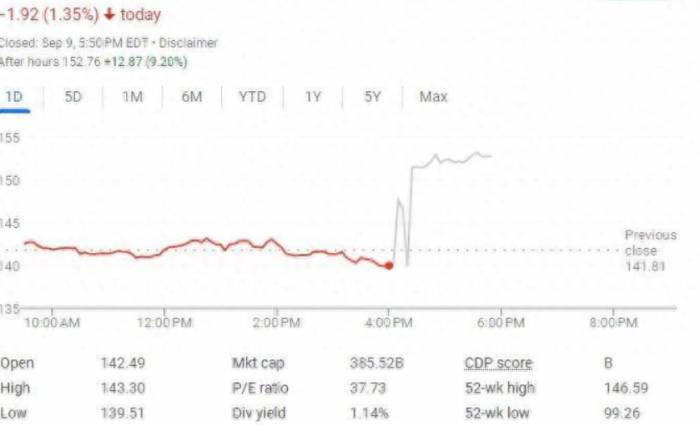
Oracle's first-quarter revenue, profit, and closely watched cloud infrastructure revenue all exceeded expectations, calling the multi-cloud agreement signed with Amazon AWS a "milestone" event. Soon, customers will be able to use the latest Oracle database technology in every hyperscaler cloud. The outlook from AI demand is optimistic, causing its stock price to soar more than 9% after hours.
On Monday, September 9th, after the US stock market closed, Oracle, the leader in database software and cloud services, released its financial report for the first quarter of the fiscal year 2025, which ended in August. Investors focused on the company's cloud infrastructure revenue growth driven by AI demand.
1) Key financial data:
- Total revenue: Increased by 7% year-over-year to $13.3 billion, with analysts expecting $13.23 billion; among them, the much-anticipated cloud infrastructure revenue grew by 45% year-over-year to $2.2 billion, with analysts expecting $2.18 billion.
- Earnings per share (EPS): On a non-GAAP basis, it increased by 17% year-over-year to $1.39 per share, with analysts expecting $1.33; on a GAAP basis, it increased by 20% year-over-year to diluted earnings per share of $1.03, compared to $0.86 in the same period last year.
- Operating profit: On a non-GAAP basis, it increased by 14% year-over-year to $5.7 billion at constant currency, with analysts expecting $5.59 billion; on a GAAP basis, it was $4 billion.
- Operating margin: On a non-GAAP basis, it was 43%, with analysts expecting 42.2%, and on a GAAP basis, it was 30%.
- Net profit: On a non-GAAP basis, it increased by 18% year-over-year to $4 billion, and on a GAAP basis, it was $2.9 billion.
- Shareholder returns: The quarterly cash dividend is $0.40 per share, and the dividend will be paid to shareholders of record as of the close of business on October 10, 2024, with a payment date of October 24, 2024.
2) Business segment data:Remaining Performance Obligations (RPO): This key metric saw a year-over-year increase of 53% to a record high of $99 billion for the company;
Cloud license and on-premises license revenue: Increased by 7% year-over-year to $870 million;
Cloud revenue (IaaS plus SaaS): Grew by 21% year-over-year to $5.6 billion, with analysts expecting $5.61 billion;
Within this, Cloud Applications (SaaS) revenue increased by 10% year-over-year to $3.5 billion, with analysts expecting $3.41 billion; Fusion Cloud ERP (SaaS) revenue grew by 16% year-over-year to $900 million; NetSuite Cloud ERP (SaaS) revenue increased by 20% year-over-year to $900 million.
3) Future performance guidance:
Oracle expects adjusted EPS for the second fiscal quarter to be between $1.45 and $1.49 per share. Revenue is expected to grow by 8% to 10% year-over-year. Cloud revenue is expected to grow by 24%-25% year-over-year. The company anticipates a doubling of expenses and a double-digit percentage increase in revenue for the fiscal year 2025.
In the first fiscal quarter, 42 new cloud GPU contracts were signed, valued at $3 billion. A strong backlog of contracts will support continuous revenue growth in the fiscal year 2025.
The biggest news is the signing of a multi-cloud agreement with Amazon AWS, where Oracle's latest technology, the 23ai version of Exadata hardware and database software, will be embedded into AWS cloud data centers, allowing AWS customers easy and convenient access to Oracle databases starting in December.
Following the earnings report, Oracle, which closed down 1.4% on Monday, surged by more than 9% in after-hours trading. The stock has gained approximately 32% this year, outperforming the S&P index.
Oracle described the multi-cloud agreement signed with Amazon AWS as a "milestone," accelerating the pace of profit growth.Oracle CEO Safra Catz stated in the earnings report, "As cloud services become Oracle's largest business, the growth of operating profit and earnings per share has accelerated."
Chairman and Chief Technology Officer Larry Ellison elaborated more specifically:
"Oracle has 162 cloud data centers in operation and under construction globally. The largest of these data centers is 800 megawatts, which will include several acres of NVIDIA GPU clusters for training large-scale AI models.
Thanks to previous multi-cloud agreements with Microsoft and Google, the company's database business growth rate is increasing. As of the end of the company's first fiscal quarter, Microsoft has launched 7 Oracle cloud regions, with another 24 under construction, and Google has launched 4 Oracle cloud regions, with another 14 under construction.
Our recently signed contract with Amazon AWS is a milestone in the multi-cloud era. Soon, customers will be able to use the latest Oracle database technology in every hyperscaler cloud."
Oracle CEO Catz had previously stated, when releasing the results for the fourth fiscal quarter ending in May, that the company is benefiting from the growing data demands for training and running AI models, signing over 30 AI-related sales contracts totaling $12.5 billion in the quarter. Despite the revenue for the quarter falling short of market expectations, this positive AI demand news still caused the stock to rise by 13% upon the news.
In terms of the most important cloud infrastructure revenue (OCI), the business revenue for this item accelerated growth in the first fiscal quarter (up 45% year-over-year), and in the just-completed fiscal year 2024, it grew by 66%, 52%, 49%, and 42% respectively in each quarter, with the total amount increasing to $2 billion in the last quarter. The company expects that the OCI revenue growth rate will exceed 50% for the fiscal year 2025, which ends in May next year.
Morgan Stanley pointed out that the scarcity of artificial intelligence AI hardware is driving the growth of Oracle's OCI business. Jefferies believes that if Oracle wants to achieve double-digit total revenue growth, it will need to see sustained OCI demand and continuous improvement in OCI capacity, at the same time, Oracle's backlog order growth must remain strong, with the remaining performance obligations in the last fiscal quarter growing by 44% year-over-year to $98 billion.
What does Wall Street think? Oracle's AI strategy is very comprehensive, but there is limited room for stock price increase.
In June, Oracle announced cloud infrastructure agreements with Microsoft, OpenAI, and Google, effectively pushing the stock price to a record intraday high of $146.59 in July.However, despite high expectations for financial reports and cloud revenue brought by AI, Wall Street analysts believe that there is limited room for Oracle's stock price to rise. Their consensus rating is "Buy," and the target price of $145.15 represents a potential increase of less than 3%.
Analysts have pointed out that in the current context of growing demand for artificial intelligence, investors will focus on the development momentum of Oracle's cloud services. The company is also very likely to announce new AI cooperation agreements and reveal plans for a new AI factory at its annual CloudWorld customer conference this week.
Furthermore, it has been analyzed that OCI (Oracle Cloud Infrastructure) is a key part of the company's transformation from a traditional database company to an enterprise cloud service provider, and it competes directly with Amazon AWS and Microsoft Azure. Given that Oracle has signed contracts with numerous AI startups and accumulated a significant amount of cloud service demand, this will help to accelerate revenue growth in the coming quarters.
It is worth mentioning that Wall Street generally recognizes that strategic partnerships will help Oracle's AI performance. In addition to a "significant cooperation" with the "most mysterious" big data company in Silicon Valley, Palantir Technologies, Oracle has been providing accelerated computing instances and software services to enterprises through OCI with NVIDIA for many years, and their collaboration in providing AI solutions has been expanded this year.
Analysts also point out that Oracle's AI strategy is very comprehensive, embedding AI capabilities into its cloud infrastructure, databases, enterprise applications, and analytical tools, and has been steadily enhancing its AI products, with a particular focus on machine learning, natural language processing, and computer vision, aiming to provide customers with smarter, more efficient, and more automated solutions. In other words, Oracle has a unique advantage in leveraging its AI capabilities to drive growth in the "cloud services and software licensing business" where OCI is located:
The company's Oracle Cloud Infrastructure (OCI) has enhanced AI capabilities, providing enterprises with powerful data analysis, automation, and decision-making tools, which are expected to continuously increase the adoption rate of OCI. This strategic move may translate into an increase in cloud revenue and an increase in market share in the competitive cloud computing field dominated by companies such as Microsoft, Google, and Amazon.