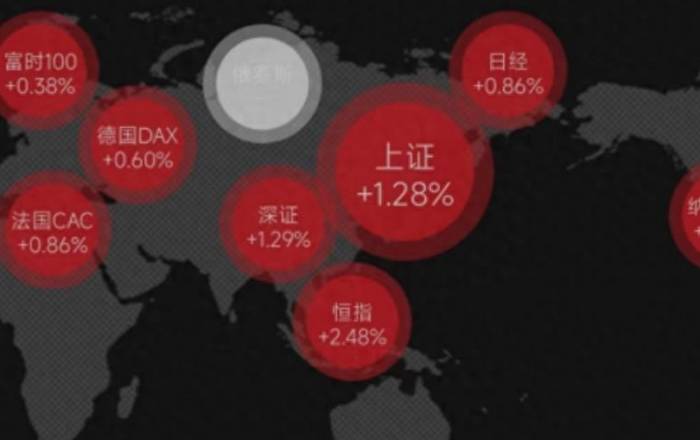
Although the U.S. CPI data for January released on Tuesday sharply contradicted the market's overly optimistic expectations for a Fed rate cut, causing a surge in the U.S. dollar index and U.S. Treasury yields, and a global stock market correction, the U.S. retail sales data for January, announced last night, significantly undershot expectations, providing some relief to the market. Last night, stock markets in Europe and America rose across the board, with the Dow Jones Industrial Average up by 0.91% and the NASDAQ up by 0.30%.
Today, the Asia-Pacific stock markets are also largely on the rise, with the Hong Kong stock market achieving a three-day winning streak. Today, the Hang Seng Tech Index rose by nearly 4%, with a rebound of nearly 7% over three days, leading the global stock markets. Additionally, the A50 futures index also rose steadily today, increasing by nearly 1.5%.
Looking specifically at today's significant news:
- Last night, the U.S. announced the initial jobless claims for the week ending February 10th at 212,000, slightly below the market expectation of 220,000, but the number of continuing jobless claims has started to rise again.
- The U.S. retail sales month-on-month rate for January was -0.8%, compared to the expected -0.1%, significantly lower than market expectations, and the retail data for December last year was also revised down from a positive growth of 0.6% to 0.4%.
After the data release, the CME "FedWatch" tool showed that the market's expectation for no rate cut in March remained almost unchanged, and the probability of no rate cut in May slightly decreased from 61% to 57%. June continues to be the time point in the market's pricing where the Fed is expected to start cutting rates, with little change in expectations.
On one hand, U.S. economic data are conflicting, with some being significantly revised downward, leading the market to even question whether the official data is being manipulated. On the other hand, the Fed emphasizes "looking at a series of data, not just one month's data," so the impact of single-month data on Fed policy decisions is minimal.
The market is now taking a wait-and-see approach. Over the past two years, the U.S. economy has repeatedly defied the market's various predictions; a recession was expected last year, but it has not occurred even this year. However, in general, the Fed will eventually cut rates; it's just a matter of when. The expectation of rate cuts is no longer the main contradiction in the market. The performance of stock markets in various countries depends more on their own fundamentals. For the U.S. stock market, the core driving force is the boost from the AI wave.When it comes to AI, early this morning, OpenAI, a global leader in artificial intelligence models, launched a model named Sora that can instantly generate short videos based on text prompts. Sora is capable of creating videos up to 60 seconds long on its own, incorporating detailed scenes, continuous camera transitions, and vivid expressions for multiple characters, all based on simple natural language descriptions.
Currently, there is limited information about Sora on the OpenAI official website. OpenAI has not disclosed the sources of the materials used to train the model. After reviewing various comments from major institutions, which are all quite favorable, we have decided not to reproduce them here. You can search and understand for yourself, and then observe the performance of the U.S. stock market tonight.
Finally, let's take a look at some data from the Chinese New Year holiday period in China:
A set of data released by Haikou Customs shows that from the first day of the Spring Festival travel rush to the Lunar New Year's Eve, which is from January 26th to February 9th this year, a total of 15 days, the amount of duty-free shopping on Hainan Island was 2.26 billion yuan, a 4.9-fold increase compared to the same period last year. The number of shoppers increased by 3.7 times, and the number of shopping items increased by 4.3 times. According to Haikou Customs statistics, during the first three days of the holiday (February 10th-12th), the sales amount of duty-free shopping on Hainan Island was 881 million yuan; the number of duty-free shoppers was 116,900; and the average consumption per person was 7,538 yuan.
According to data from the Lantern Professional Edition, as of 13:15 on February 16th, the total box office for the year 2024 (including pre-sales) has exceeded 10 billion, of which the total box office for the Spring Festival period (including pre-sales) has already exceeded 7 billion.
Compared to the same period in 2019, during the first 19 days of the Spring Festival travel rush, 1) Railways: passenger traffic increased by 24%; 2) Civil aviation: passenger traffic increased by 19%; 3) Highways: the volume of personnel movement increased by 10%; 4) Water transport: passenger traffic decreased by 52%. Airlines generally implemented active revenue management strategies, with stable and rising ticket prices before the festival, without the "dive" phenomenon that the market was worried about; pre-sales during the festival were good, and the load factor will support ticket prices to remain high; pre-sales for the post-festival return peak (the 6th to the 8th day of the first lunar month) were high, which may set a peak for Spring Festival ticket prices.
Due to being at home for the holiday and time constraints, we did not compare some data with previous years. However, judging from the performance of the Hang Seng Index, sectors such as consumer goods, media, retail, and aviation have all received very positive feedback. We will wait for more information after the weekend data is released.
As of the closing, the Hang Seng Index increased by 2.45%, and the Hang Seng Technology Index increased by 3.77%. Looking at the sectors, media, food and major goods retail, biopharmaceuticals, healthcare, real estate, automobiles, food and beverages, and other industries led the gains. WuXi Biologics rebounded sharply by nearly 12%, Meituan increased by nearly 5%, Alibaba increased by more than 2%, Tencent Holdings increased by more than 2%, Xiaomi Group increased by more than 5%, and Sunac China increased by more than 12%.
This year, there may be four threads for A-shares: First, the market value management of central and state-owned enterprises, which overlaps highly with high dividend stocks. In the context of asset scarcity, large funds such as insurance capital still have the willingness to buy high dividend stocks; Second, under a series of policy intensifications, whether the real estate market can stabilize, the real estate chain chips are very clean, institutions are ultra-lowly allocated, and the performance is very poor, with the possibility of a turnaround in difficult situations; Third, whether the central bank can fulfill its commitment to promote the rise of CPI, if CPI rises, the deflation theory will be proven wrong, and consumer stocks such as food and beverages have also been fully adjusted; Fourth, high-tech such as AI.Risk Warning:
The stock market involves risks, and investment should be approached with caution. This article does not constitute investment advice, and readers should think independently.