We have always said that Murphy's Law is more likely to occur in the stock market because the stock market has a self-reinforcing nature (leverage and herd effect). Once a liquidity crisis occurs, if there is not enough external force to intervene, then any worse outcome will lead to an even worse outcome.
We have been urging the management to be aware of the risks in the stock market and to increase the efforts to rescue the market. However, the liquidity crisis in the A-share market has finally reached the stage of forced liquidation of equity pledges.
This morning, we have been busy taking screenshots. For us, who are relatively new to the stock market, although we often talk about the stock market crash and circuit breakers in 2015, we actually cannot feel the actual misery. The screenshots we took this morning showed that the number of stocks hitting the limit down was close to 1300, and more than 3600 stocks fell by more than 9%. If calculated by a 10% limit down, the number of stocks hitting the limit down would exceed 3000. But just after the market closed, we took a look again, and even though the national team made an effort to rescue small and medium-sized enterprises in the afternoon, there were still more than 1300 stocks hitting the limit down at the close, and nearly 3000 stocks fell by more than 9%, which is a bit better than the morning.
Today's sharp drop can be said to be expected. This is what happens when a liquidity crisis continues to unfold, with a lack of buying orders and only selling orders. Leverage and derivatives will play an accelerating role, and the wave of forced liquidation will continue to spread until it triggers all leverage. Last Thursday, we reprinted the institution's calculation of the snowball product, and at that time, the products linked to the CSI 500 and CSI 1000 were about a quarter left. After the sharp drop on Friday and today, they should have been basically cleared.
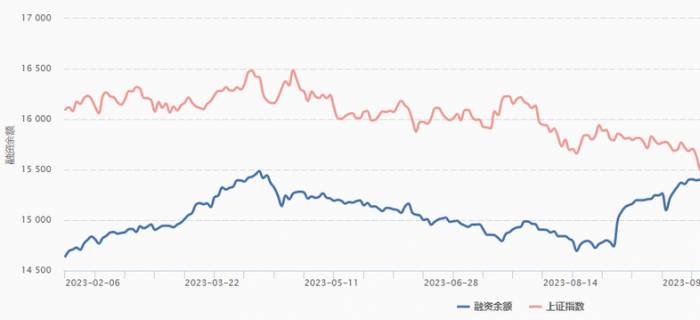
Let's look at the financing again. On Friday alone, the financing position was reduced by 30 billion, and the financing position was reduced by 71.4 billion last week, and the financing position was reduced by 119.3 billion since the beginning of the year. Today, the financing position was reduced by at least 30 billion, and it is not exaggerated to say 50 billion. After the market closed today, the financing balance of the two cities should have broken through the level of April and October in 2022. Of course, it is hard to say that breaking through the level of the April 2022 epidemic bottom is in place. If small and medium-sized enterprises continue to collapse, then financing will continue to kill, and financing lags behind market sentiment, so it is necessary to stabilize market sentiment before financing can stabilize.
Finally, there is the equity pledge. Today, during the market, the Securities Regulatory Commission made an emergency statement on equity pledges. The Securities Regulatory Commission pointed out that, looking at the situation since the beginning of the year, the scale of pledges has decreased compared to the end of last year. It is necessary to guide securities companies and other institutions to increase the elasticity of the liquidation line and promote the smooth operation of the market. The Securities Regulatory Commission closely monitors and takes strong measures to prevent the risk of stock pledge.
No matter how to analyze, it is still that sentence, the liquidity crisis must be solved by liquidity. Only the national team or the stabilization fund can strongly support the market and reverse the panic selling sentiment of the market, and the liquidity crisis can be solved. Without real money, other things are not worth talking about, and the national team must let the market believe that you have enough money. If the bottom support fails at the critical moment, it will only make the market more skeptical, thereby increasing the selling strength.Let's take a look at the details of today's large capital market intervention. In the early session, A-shares plummeted, while Hong Kong stocks barely fell. Those in the know realized that the A-share decline was not due to fundamental reasons but entirely a liquidity issue.
At the opening, large capital began to buy in, but the approach was the same as before, focusing on the Shanghai 50 ETF and the CSI 300 ETF. However, as the scenario of a thousand stocks hitting the daily limit down unfolded, panic spread, and the market could no longer hold steady. All three major indices plunged, with the Shanghai Composite Index breaking through the previous low of 2,666 to a new low of 2,635. The ChiNext Index fell more than 4% at one point, breaking below 1,500 points, and the small-cap stocks represented by the CSI 1000 Index were close to hitting the daily limit down.
During the midday session, large capital realized that merely buying large-cap ETFs was not enough and began to shift strategies to buy the CSI 500, CSI 1000, and ChiNext Index ETFs. The ChiNext Index surged, rising more than 3% at one point, with an intraday fluctuation exceeding 7%. By the close, the turnover of the CSI 500 ETF reached 16.1 billion yuan, the CSI 1000 ETF reached 8.7 billion yuan, and the ChiNext ETF reached 9.549 billion yuan, all setting historical records for the highest turnover.
In fact, large capital continued to buy until the end of the day, but the market was very concerned about the next day, leading to a significant sell-off after the rally, which resulted in an increase in the number of stocks hitting the daily limit down at the close. Today's market intervention could not be considered very successful, especially when compared to 2015, when the central bank provided unlimited liquidity. Now, the market has doubts about the strength of large capital, after all, the stabilization fund has not been approved yet.
Finally, looking at the market performance, by the close, the Shanghai Composite Index fell by 1.02%, the ChiNext Index rose by 0.79%, the Hang Seng Index fell by 0.15%, and the Hang Seng Tech Index fell by 0.17%. The total turnover of the two markets expanded to 870 billion yuan, and the net purchase of northbound capital was 1.211 billion yuan. Foreign capital has already started to continuously buy A-shares. Although there are some funds disguised as national team funds, foreign capital is indeed buying A-shares, as can be seen in the second chart, which shows the inflow of funds into Chinese stock funds at a ten-year high.
Risk Warning:
The stock market is risky, and investment should be approached with caution. This article does not constitute investment advice, and readers should think independently.